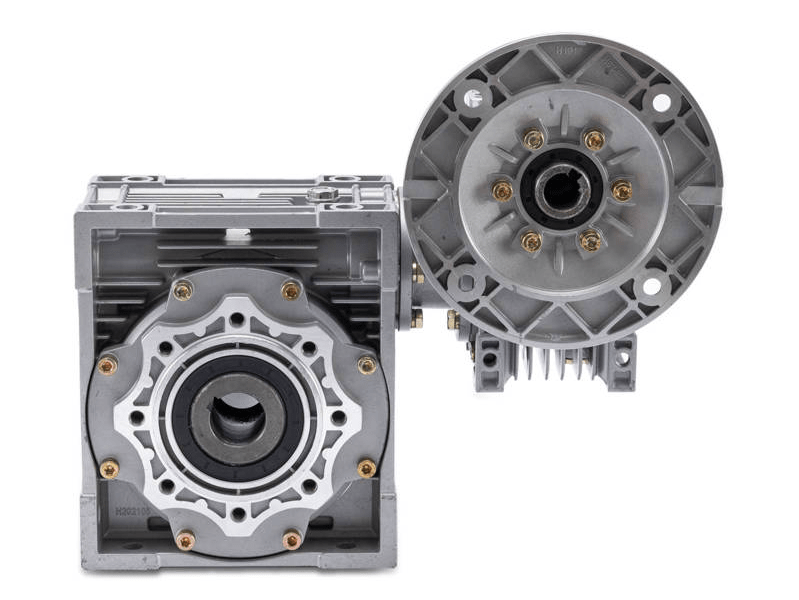
The reducer is an independent component consisting of gear transmission, worm transmission, and gear-worm transmission enclosed in a rigid shell. It is often used as a reduction transmission device between the original moving part and the working machine.It plays the role of matching speed and transmitting torque between prime mover and working machine or actuator, and is widely used in modern machinery.During the use of the reducer, it is also necessary to learn to check and maintain it to prolong the service life of the reducer. It is recommended to carry out inspection and maintenance from the following aspects:
1. Check and ensure the normal operation of the boot device
Check whether the contactor contacts, coil cores and wiring screws are reliable, and whether the mechanical parts are flexible, so as to maintain a good technical condition and ensure that the reducer will not burn when it starts.The technical state of the reducer starting device plays a decisive role in the normal start of the reducer.Practice has proved that the vast majority of burning reducers are mainly caused by improper operation of starting equipment.
2. Keep the reducer clean
When the reducer is running, there must be no dust, water stains and other debris at least 3 meters around the air inlet to prevent the inside of the reducer from being pulled out, short-circuiting the medium or damaging the insulation layer of the wire, resulting in inter-turn short circuit, increased current, increased temperature, and deceleration. burnout.Therefore, in order to ensure that the reducer has sufficient insulation resistance and a good ventilation and cooling environment, the reducer can maintain a safe and stable working state in long-term operation.
3. Check transmission and rotating parts
Check whether the transmission is flexible and reliable; the concentricity of the coupling is standard; the flexibility of the gear transmission, etc.If you find something stuck, stop immediately to find the cause and run.If the reducer is overloaded, the main reason is that the drag load is too large, the voltage is too low or the mechanical blockage caused by the drive.If the overload time is too long, the reducer will absorb a large amount of active power from the grid, the current will increase sharply, and the temperature will increase accordingly.At high temperatures, the insulation of the reducer will age and burn.Therefore, please keep the reducer running at the rated current.
4. Current detection
When the reducer runs beyond the rated current, the temperature of the coil will rise, resulting in deterioration of the insulation, shortening the service life or burning out the coil, so the load should be reduced to make it lower than the rated current.
5. Check the temperature of the reducer
If the reducer runs under load and the voltage is rated or unbalanced for a long time, when the temperature rises too high due to poor ventilation, the insulation will deteriorate and the life will be shortened.
6. Insulation resistance test
When the reducer is placed in high-humidity air, when the stop time is long or the ambient temperature changes sharply, the electrical performance will decline due to the hygroscopicity of the insulating layer.In addition, water or adhesion attached to the surface of the insulator will also reduce the insulation resistance.Therefore, before the insulation resistance, it must be checked regularly.
7. Check bearings and lubricating oil
Rolling bearings used in small and medium reducers are usually sealed with oil.Sealing grease is usually lithium-based grease, high temperature resistance, stable mechanical properties, and a service life of about 30,000 hours.The service life of the grease can be said to be the service life of the bearing.The grease standard of the reducer is usually replaced every 6 months, depending on the actual use environment and use time.