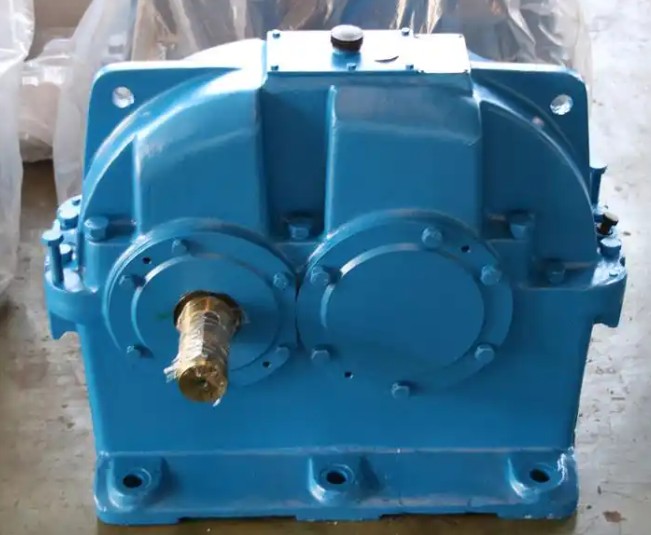
The ambient temperature directly affects the power matching, lubrication status, thermal balance, operating accuracy and service life of the motor and ZSY280-35.5 gear reducer. Abnormal temperature will lead to unbalanced adaptation of the whole machine, increased faults and shortened service life.
1. High temperature environment (>40℃, exceeding 45℃ is a severe working condition)
1. Impact on the motor : The ambient temperature rises, the heat dissipation of the motor deteriorates, the aging of the winding insulation accelerates, and the service life decreases significantly every time the temperature exceeds 10°C; the motor loss increases, the efficiency decreases, and it needs to be used at a reduced capacity, otherwise it is easy to overheat, trip, and burn; the bearing grease becomes thinner and lost, causing abnormal noise and jamming.
2. Impact on the ZSY280-35.5 reducer : the viscosity of the lubricating oil decreases, the oil film is easy to rupture, and the tooth surface and the bearing are prone to dry friction, pitting, and gluing; the thermal expansion of the gear and bearing causes the meshing gap to become smaller, the vibration and noise to increase, and even stuck and broken teeth; the seals accelerate aging and hardening, resulting in oil leakage, dust and water intrusion.
3. Impact of system adaptation : The output torque of the motor decreases, the friction loss of the reducer increases, and the output capacity of the whole machine is insufficient; the coaxiality of the motor and the reducer is damaged due to thermal deformation, the vibration intensifies, and the coupling, shaft, and key are easily damaged.
2. Low temperature environment (<0℃, below -10℃ is severe working condition)
Impact on the motor : The lubricating oil (grease) is thick, the starting resistance increases, the starting current soars, and it is easy to be overloaded; the temperature difference after shutdown can easily cause winding condensation, insulation degradation, and the risk of leakage and short circuit; cold shrinkage of materials may cause abnormal fit gaps and increase vibration and noise.
Impact on the ZSY280-35.5 reducer : the fluidity of the lubricating oil becomes poor, and gears and bearings are prone to dry grinding due to lack of oil during startup, and wear increases sharply; the toughness of gear and bearing materials decreases, and the impact resistance is reduced, and teeth are prone to chipping and cracking under impact loads; the starting torque increases significantly, which can easily cause motor overload and transmission parts to break.
Impact of system adaptation : The starting torque of the motor does not match the low-temperature resistance of the reducer, and it may fail to start or stall; frequent hot and cold cycles lead to seal failure, loose bolts, and coaxiality drift.
3. Normal temperature environment (0℃~40℃)
This is the best adaptation range between the motor and the ZSY280-35.5 reducer. The motor can be matched according to the rated power. The reducer can use standard industrial gear oil. Natural cooling meets heat dissipation. The oil temperature, vibration and noise are stable, and the equipment can operate reliably for a long time.
4. Temperature adaptation core control requirements
1. The recommended working oil temperature of the reducer is 40°C ~ 60°C, with the maximum temperature not exceeding 80°C, and the temperature rise not exceeding the ambient temperature + 40°C.
2. In high-temperature environments, it is necessary to reduce the motor capacity, use high-temperature lubricating oil, and strengthen heat dissipation; in low-temperature environments, it is necessary to preheat the lubricating oil, use low-condensation point oil, and prohibit direct startup with load.
3. When the temperature is abnormal, give priority to adjusting lubrication, heat dissipation, and preheating measures, and then check the motor power and reducer carrying capacity to ensure reliable adaptation of the entire machine.