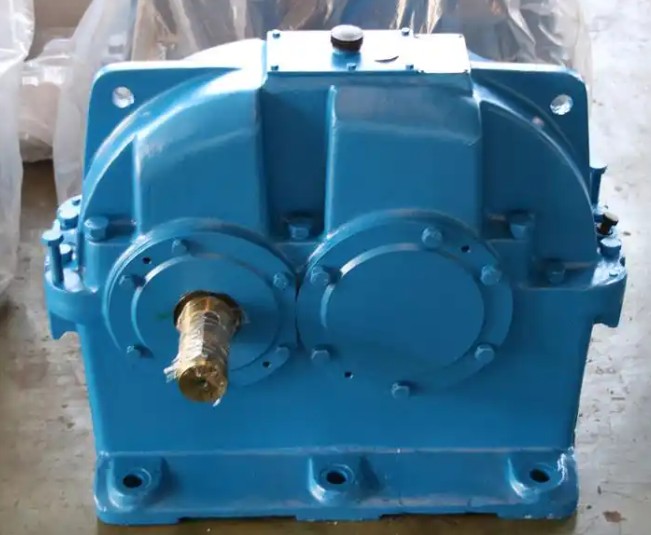
The maintenance of the ZSY315-31.5-I gear reducer coupling is a key link to ensure the stable operation of the equipment. It must systematically extend its service life and reduce the risk of sudden failure through regular inspection, precise alignment, reasonable lubrication and timely replacement of aging parts. Combined with the characteristics of high torque and heavy load working conditions of this type of reducer, the following is the specific maintenance plan:
1. Daily inspection and operation monitoring
1, temperature and vibration monitoring
During operation, the temperature rise in the coupling area shall not exceed the ambient temperature +35°C, and the shell surface temperature shall be lower than 80°C;
Use a portable vibration meter to detect the vibration speed. The vibration speed should be ≤2.8mm/s (ISO 10816 standard). An abnormal increase indicates poor alignment or component wear.
2. Appearance and fastening status inspection
Visually inspect the coupling weekly for cracks, deformation or oil leakage;
Focus on checking whether the connecting bolts are loose. It is recommended to use a torque wrench every 15 days to retighten to the specified torque (for example, M16 bolts are 180–220N·m), and install anti-loosening washers.
3. Abnormal noise identification: If there are periodic abnormal sounds such as 'clicking' or 'gnawing teeth', it may be due to damage to the elastomer or meshing deviation, and the machine needs to be stopped immediately for investigation.
2. Lubrication management and seal maintenance
1. Lubrication cycle and grease selection
Elastic couplings (such as plum blossom type, pin type) are filled with lithium-based grease (such as NLGI 2# extreme pressure lithium-based grease) every 3 months;
The gear coupling should be replaced with grease every 6 months. It is recommended to use high-temperature grease containing molybdenum disulfide to prevent tooth surface gluing caused by dry grinding.
2. Key points of lubrication operation
Clean the oil nozzle before filling to prevent dust from entering;
Fill until the old grease is evenly squeezed out from the gaps to avoid excessive increase in internal pressure.
3. Sealing status inspection
Check whether O-rings and oil seals are aged and cracked. Especially in high temperature or dusty environments, the replacement cycle should be shortened;
If oil leakage is found, the seals must be replaced immediately and the oil stains must be cleaned to prevent secondary pollution.
3. Installation accuracy control and alignment correction
Radial deviation ≤ 0.02mm
Axial deviation ≤ 0.05mm/m
End clearance: 0.2–0.5mm (adjusted according to coupling model)
It is recommended to use a laser alignment instrument for four-point measurement, record the position readings at 0°, 90°, 180°, and 270°. After calculating the deviation, adjust it by adding or subtracting spacers;
If there is no laser equipment, the double-meter method (radial + axial dial indicator) can be used for precise alignment.
It is forbidden to directly hit the coupling with a hammer. You can use a copper rod to tap or press in with a hydraulic tool;
The heating temperature should not exceed 120°C during hot loading to avoid overheating and annealing of the material.