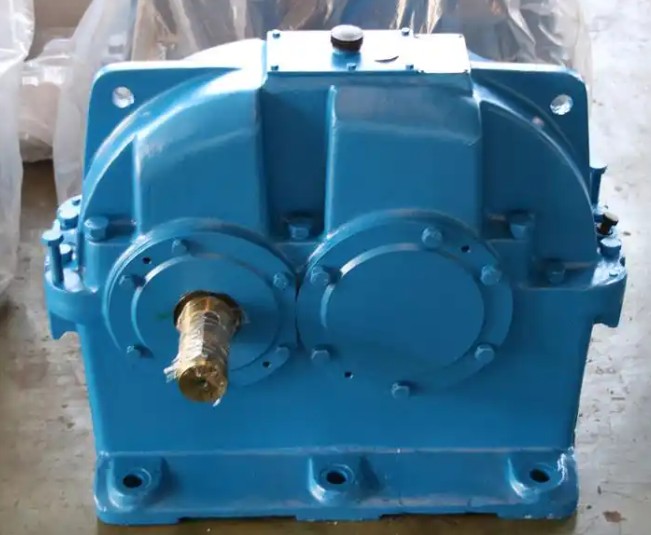
The reasons for poor gear contact of the LY250-21.73-II reducer can be summarized into four categories: substandard manufacturing accuracy of parts, assembly process deviation, improper lubrication and maintenance, and problems with working conditions and installation foundation, as follows:
1. Parts manufacturing accuracy defects
Gear machining errors: Cumulative errors of tooth shape, tooth direction, and tooth pitch are out of tolerance (not meeting the design level 6 accuracy requirements). The tooth surface roughness Ra value is too large, resulting in uniform contact during meshing; the gear deformation is not corrected after carburizing and quenching, and the tooth surface warps.
Box processing deviation: Bearing hole coaxiality and parallelism are out of tolerance (allowable value ≤ 0.02mm/m), center distance deviation exceeds the design range, resulting in gear axis position deviation and uneven load during meshing.
Insufficient bearing accuracy: Use bearings with an accuracy lower than P5 level, or the bearing clearance is too large/too small, and the shaft system moves or tilts during operation, damaging the gear meshing position.
2. Deviation in assembly process operation
Axis alignment is not in place: a laser tracker or precision level is not used to correct the parallelism of the input and output shafts during assembly, or the thickness error of the gear axial positioning gasket is too large, resulting in unbalanced contact load in the tooth width direction.
Parts are not cleaned properly: iron filings, burrs, and oil stains remain on the tooth surface and bearing holes. Foreign matter is caught on the meshing surface after assembly, causing stress concentration at local contact points and uneven distribution of spots.
Loose fasteners: The gear lock nut and bearing end cover bolts are not tightened according to the specified torque. The gear moves axially or the shaft system shifts during operation, causing fluctuations in the contact state.
3. Improper lubrication and maintenance management
Lubricating oil Selection Error: No suitable extreme pressure gear oil (L-CKD 320/460 is recommended) is used, the oil viscosity is insufficient or there is no extreme pressure additive, and a stable oil film cannot be formed on the tooth surface, resulting in dry friction or semi-dry friction.
Oil contamination and deterioration: The cleanliness of the oil does not meet the NAS level 8 standard, and impurities enter the tooth surface causing abrasive wear; the lubricating oil is not replaced for a long time, and the lubrication performance decreases after oxidation and deterioration, destroying the contact state.
Abnormal oil level: If the oil level is too high, the oil stirring resistance will be large and the oil temperature will rise. If the oil level is too low, the tooth surface lubrication will be insufficient, which will lead to local poor contact.